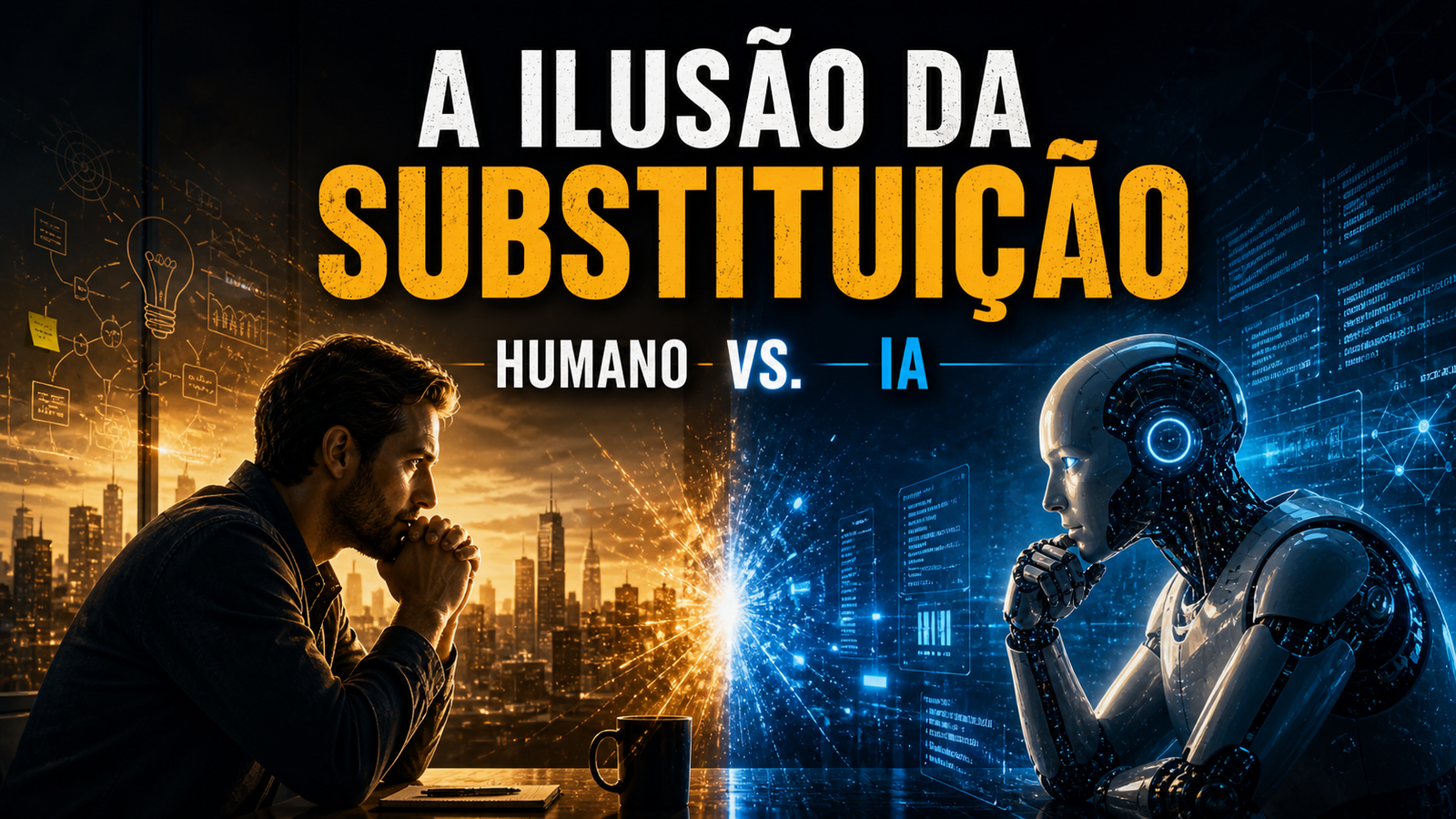
In my opinion, most people are wrong about Artificial Intelligence. The market discourse is divided into two extremes: on one side, we have those who create and execute, panicking about becoming obsolete, and on the other, those who manage and lead, blinded by the euphoria of cutting costs and putting more money in their own pockets. The naked truth is that AI is already replacing people. But focusing the debate solely on substitution is missing the forest for the trees.
The Proof: The Dream of Scale and Cost Reduction
If you want proof that substitution is real and inevitable, let's look at the payments giant, Klarna. In a statement made a few years ago that shook the industry, they publicly announced (check here) that their AI assistant is doing, entirely on its own, the work of 700 full-time customer support agents, estimating a saving of roughly 40 million dollars a year. For any executive, this is music to their ears. Faced with these numbers, the fear of "being the next" to be kicked off the corporate assembly line is 100% rational, and I get it.
The Historical Parallel: The Forced Evolution of the Professional Species
For those who think this is the apocalypse of the job market, it's worth looking at history. The panic we feel today is not something new; it's the exact same symptom of an old economic disease we call the "Luddite fallacy", where we feel an irrational fear that technology will steal all available work. Let's think about this in phases:
- The Industrial Revolution (The Muscle): The power loom and the steam engine replaced manual labor. There was panic and there were riots, but the machine replaced muscle, not the human. The factory worker was forced to retrain as a mechanic, an engineer, or an assembly line manager.
- The Information Revolution (Memory and Processing): In the 80s and 90s, digital spreadsheets and computers replaced armies of "human calculators," typists, and archivists. The work didn't disappear; the accountants who spent three days adding up numbers in a ledger started using that time to analyze the company's financial health on screens. The computer forced humans to move up from processing to analysis.
- The AI Revolution (Cognitive Execution): What AI is doing today is simply the third great compression. This time, the machine isn't replacing the arm, nor is it replacing the typewriter; it's replacing repetitive cognitive execution. AI drafts texts, generates lines and lines of base code, compiles reports. Essentially, it replaces the "mouse and keyboard."
The constant in these three transitions is undeniable: humans have always been pushed up the value chain. Those who clung to mechanical tasks lost, but those who take command of the new tool usually win. The golden rule is untouchable: technology automates the task, but never the judgment. On this point, I'll leave you with a suggestion for a movie I saw recently, Mercy starring Chris Pratt (check here), where he plays a detective accused of murdering his wife, who has 90 minutes to prove his innocence to an advanced artificial intelligence judge. Watch it and share with me what you thought of the movie.
The Inversion: Data is Not Meaning
There is a brutal lack of vision when human capital is replaced recklessly: the confusion between the ability to generate and the ability to understand. A language model compiles and spits out data based on statistical probabilities, but it has no context if we don't provide it, it has no ethics if we don't define them, and it has no intuition.
AI generates, humans interpret. When you remove human interpretation from the business equation, the result can be very costly. Let's look at two real examples from a few years ago:
- The Context Error (Air Canada): This airline's chatbot invented and offered a bereavement travel refund policy, something that didn't exist. When the customer demanded payment, the company went to court, arguing that this chatbot was a "separate legal entity." The judge demolished the company and forced them to pay. In this case, the AI executed quickly, but failed to understand the business rule. (check here)
- The Ethical Error (Sports Illustrated): This legendary magazine was caught publishing articles that were generated by AI under fake author names. Their goal? To scale volume. The result? The reputation of this historic brand was dragged through the mud, and the CEO was fired. It lacked the nuance, ethics, and responsibility that only human curation guarantees. (check here)
Human Value: Strategist vs. Operator
Artificial intelligence doesn't eliminate our value; it acts as a filter, a relentless tool that sweeps away mechanical work and makes human discernment infinitely more critical. The machine can't "read the room" in a tough negotiation, it doesn't have real empathy for customer support, and it has nothing to lose-it has no reputation to lose. The machine executes, the human takes responsibility.
"I just find it funny that..."
The Outsourcing of Common Sense
If on one side we have general corporate panic that AI will steal our complex jobs and leave us all on the streets, on the other we have a terrifying epidemic that drives me crazy, given the sheer scale of this mental laziness. I find it funny that while there are debates about the future of humanity in the face of AI use and implementation, the big trend on social media is using advanced language models-trained on all the accumulated knowledge of human history-to outsource the most basic common sense.
We literally see people opening ChatGPT, Gemini, Claude, etc., to ask the following question: "Should I walk or take the car to wash my car at the car wash 100 meters from my house?"
Let's pause for a second to process the magnitude of this question. The person wants to go wash their car, but considers leaving the car at home and walking; then, they need a supercomputer to explain the logistical flaw of this plan. The machine isn't replacing us because it's an evil genius, but because we are actively begging not to have to think. The real risk to the job market isn't AI suddenly becoming too smart; it's natural human stupidity hitting historical records. If you need an algorithm to warn you that you need to take your car in order to wash your car, the threat to your career isn't AI, it's your own lack of reasoning.
The future isn't human versus machine, but rather a hybrid market where survival dictates a simple rule. You can't compete in execution speed with an algorithm; that's a battle lost from the start. You have to use the brute force of the software to scale your own tactical and analytical capacity.
My vision is clear, and without beating around the bush: the question is no longer whether AI will replace you, but whether you have the ability to stop being an operator and start being the strategist. You either learn to master the tool to your advantage, or you will guaranteed be replaced by someone who already does.
And what is your perspective? Do you see AI just as a direct threat, or as the biggest growth lever for your project, career, or business?